Christmas Candles From a Kit: Plan, Pour and Give a Batch
By Nadia Colbert, candle maker since 2014 · Updated
Pouring one candle for yourself and pouring a dozen to give away are two different projects. The second has a deadline, a repeat count, and a moment where somebody who did not make the candle has to be able to light it safely. This guide is about that second project: what one kit produces for a season of giving, when the pouring has to happen, and the decisions that separate a matched set from fourteen odd survivors of a long evening.
In this guide
What the kit lets you make — the real contents.
Working backwards from the date — the cure decides the weekend.
Pouring a series, not a candle — melt order, scent and color.
Containers, including salvaged ones — and their limits.
Presenting and labeling — what belongs on the tag.
A candle that leaves your house — the fire safety part, sourced.
What ruins a batch — the five failures that scale.
What the Kit Lets You Make for Christmas
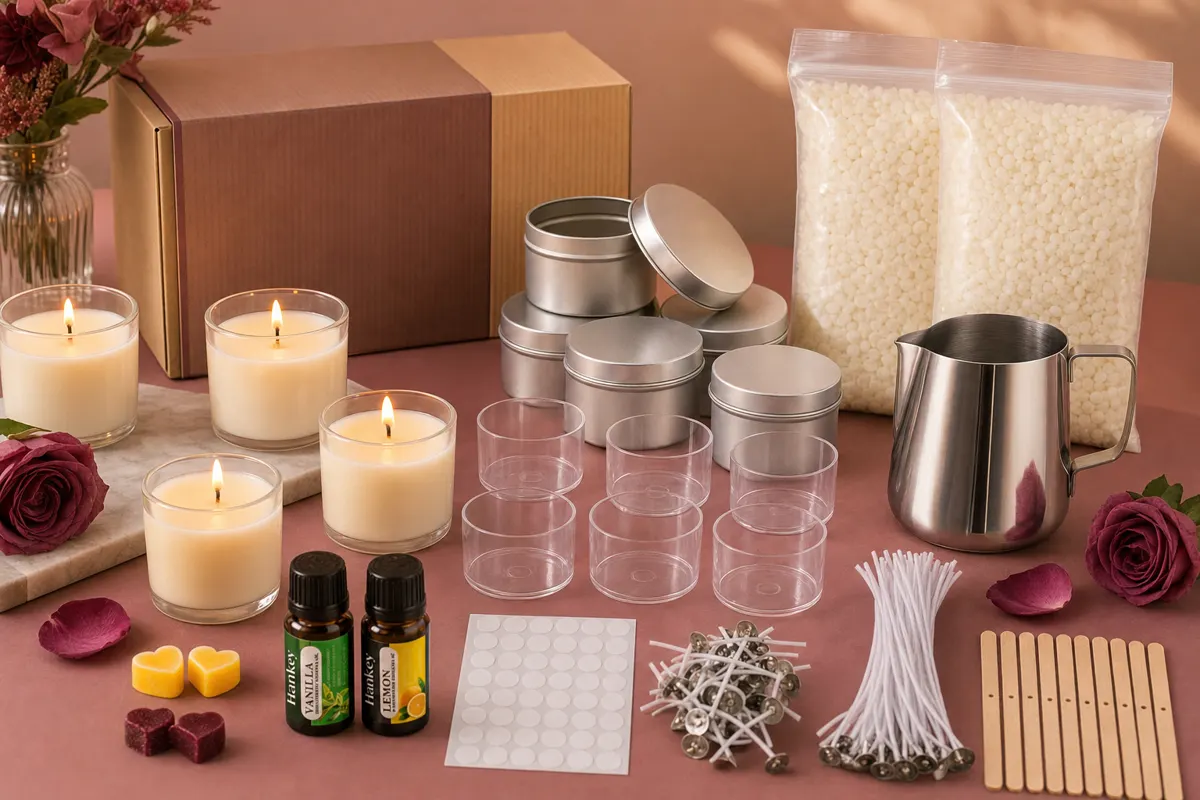
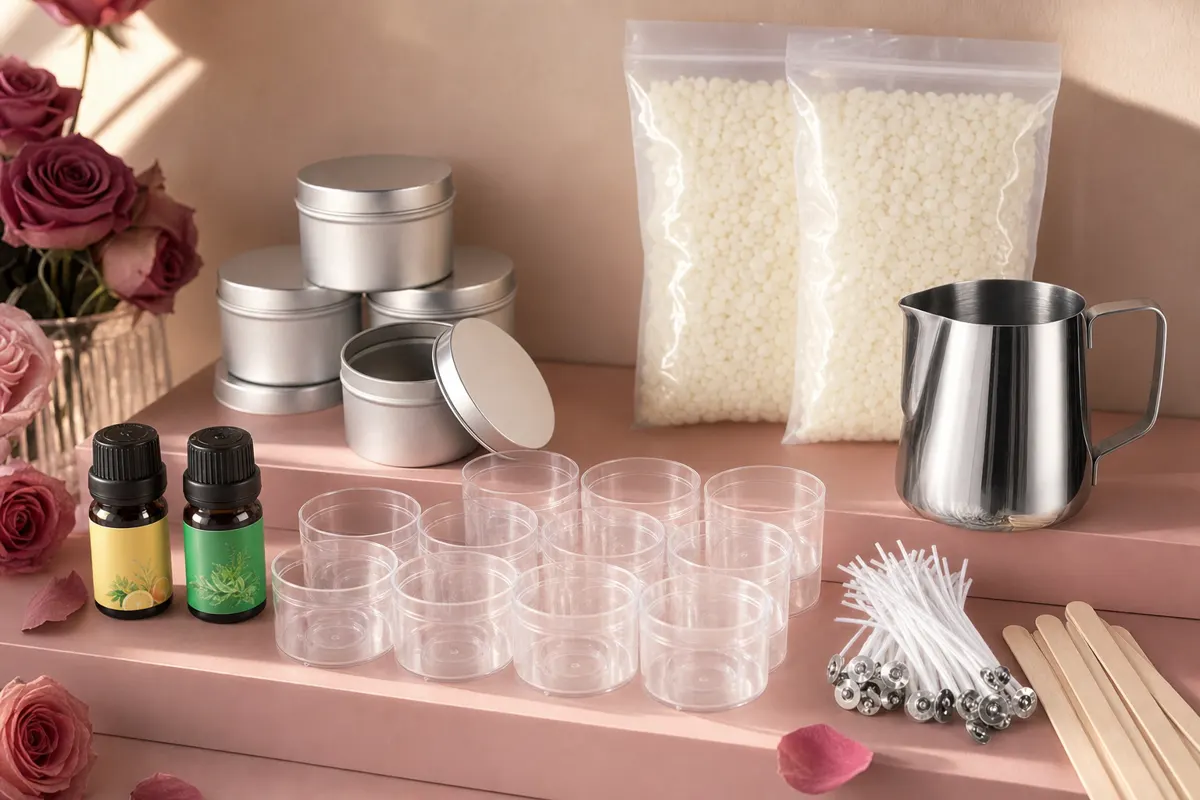
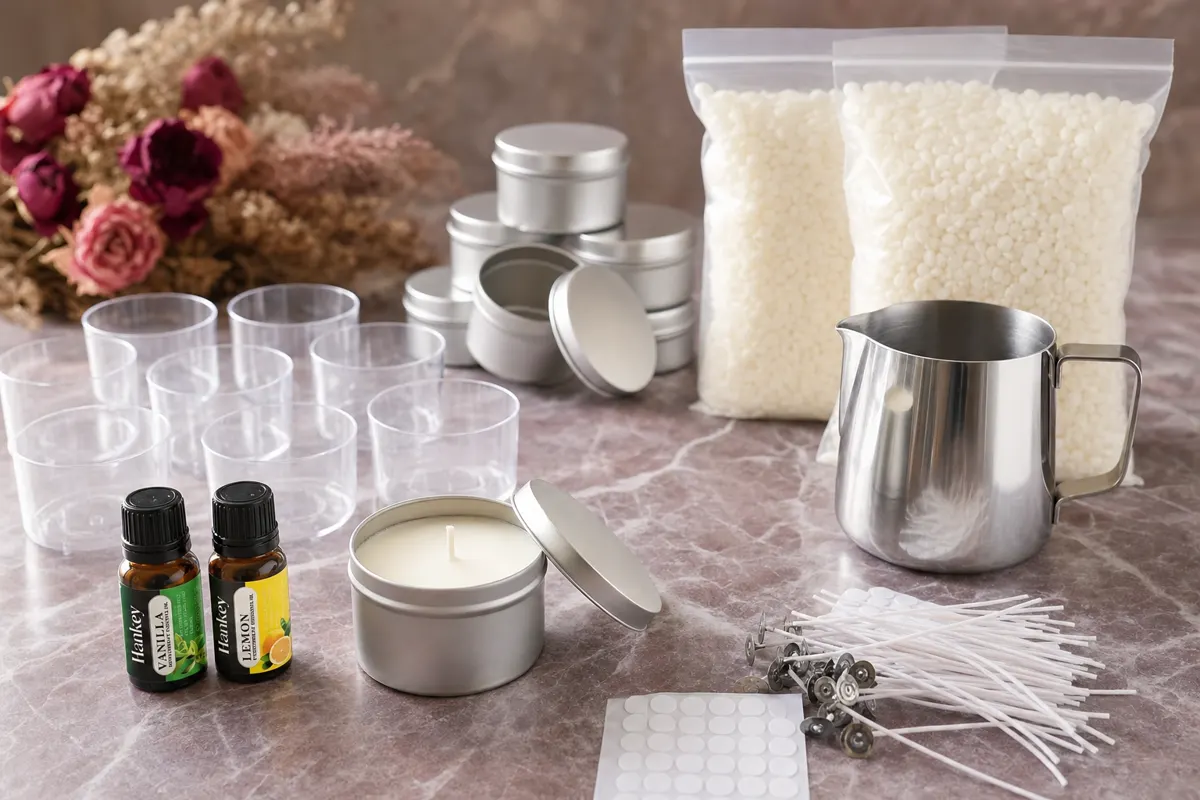
A giving plan built on the wrong inventory falls apart on the evening it matters. The candle making kit contains a stainless steel melting pitcher, two bags of soy wax, fifty pre-waxed wicks plus twenty spares, four candle tins with lids, ten plastic candle jars, two fragrance oils in lemon and vanilla, four color dyes, two wooden centering devices, a stainless steel spoon, fifty-six glue dots and a user manual, and the supplies page takes each piece in turn.
Two of those lines shape a Christmas batch more than the rest. The first is the scent list: lemon and vanilla is the palette you are pouring from. Vanilla carries a winter set on its own, and lemon reads bright rather than seasonal, a useful contrast across more than one candle. Anything beyond those two bottles is a separate and deliberate purchase, and the fragrance oil guide is written for it. An oil from the kitchen cupboard is not a stand-in: the two bottles in the box are matched to this wax.
The second is the container split. Four tins and ten jars are not fourteen equivalent gifts. The tins have lids, so they close, travel and stack; the jars are small. On outside dimensions a tin is 2.36 by 1.57 inches and a jar 1.54 by 0.98 inches, which the wick size guide works out to a little under four fluid ounces and roughly one fluid ounce of space. Knowing that before you pour is what stops you promising fourteen identical candles to fourteen people.
Working Backwards From the Date
This is the one part of a giving batch that cannot be compressed by working harder. The active session is an evening; the wait afterwards is not negotiable, because wax and fragrance oil keep binding well after the surface has hardened, which is why the soy walkthrough treats the cure as part of the recipe rather than as storage. A candle poured on the twenty-third and wrapped on the twenty-fourth is one whose scent the recipient meets at its weakest.
So put the cure in the calendar first and fill in backwards. If the candles change hands in the last week of December, pouring in the first week gives you the full one-to-two-week window with margin. Ahead of that, one test pour in each container style answers what only a burn can answer, and the wick size guide's rule of giving a new candle at least 48 hours before you test it applies to that test candle too. Two weekends, not one.
Pouring early buys a second thing. A batch of fourteen throws up at least one surprise, and a surprise met in the first week of December is a re-pour rather than a gap in your list — soy goes back into the pitcher and pours again, which only helps while there is time on the clock.
Pouring a Series Instead of a Single Candle
The mechanics of one candle are covered step by step in how to make candles at home, and a batch changes none of them. What changes is the sequencing, and three habits carry it.
One scent per melt. Fragrance goes into the pitcher, not into the container, so every vessel filled from the same melt carries the same scent at the same strength. Deciding how many lemons and how many vanillas you want before you melt anything turns that constraint into an advantage: two clean sub-batches instead of fourteen slightly different candles. Keep the wax you are not pouring solid in the bag — it reheats without harm.
Line the containers up first. Wicks stuck with glue dots and held by the centering devices, all of them ready, before any wax is hot. Pouring is the only step with a clock on it, and a batch goes wrong when somebody hunts for a glue dot with a full pitcher in one hand. With two centering devices you move them along as candles set, which is another reason to pour in small groups.
Give the colors one logic. Dye goes in as a shaving stirred through the melt, so the useful variable is depth rather than hue: one block runs from barely tinted to solid. Since fragrance is fixed per melt, color is what tells someone which candle is which — one family for the vanilla melt, another for the lemon. Do not add anything to the melt that did not come as a candle-making product, however festive it looks: dried botanicals, glitter and food coloring are not fragrance oils and dye blocks, and a burning candle is not the place to find out how something behaves.
Then set the poured candles somewhere still and warm and leave them there. Moving them to a cold room to speed things up is what produces cracks and frosted sides, and on a batch it produces them fourteen times over.
Containers, Including the Ones From Your Recycling
Pouring into salvaged jars comes up every December, and it is the point where a batch stops being predictable. The reason has two halves.
The first is wicking. Container width decides wick size, not height, which is why the same wick that behaves perfectly in a slim jar tunnels badly in a wide one. The wicks in the box are chosen for the tins and jars in the box; put them in a vessel of a different diameter and you are running an experiment you can only read by burning it. That is fine in October and expensive in December.
The second is the glass itself. A container holding a lit candle is holding a heat source for hours. Ordinary food jars, drinking glasses and decorative glassware are not made or tested for that, and glass not intended for heat can crack — and nobody can tell from the outside which one will. That uncertainty is one thing on your own counter under your own eye, and another in a candle somebody lights in a room you are not in.
So the line for a Christmas batch is simple: give from the containers that came matched with the wicks. The four tins close, which makes them the ones that survive a coat pocket and a car journey; the ten jars read as an extra alongside something. Save any other vessel for a test burn in the new year, with the wick size guide open.
Presenting and Labeling a Candle You Are Giving
The tins are the easy case, because a lid gives you a flat surface to hold a label; the jars are small enough that a tag on twine usually beats a sticker. Either way the content matters more than the craft of it.
Scent first, because two candles poured from the same wax look identical and are not. The pour date second: it dates the candle and tells the person holding it that it has cured. A care line third, and this is the one people skip. The troubleshooting guide exists because a candle's first burn sets its habits, which a recipient has no reason to know. One sentence asking them to let the first burn reach the edge of the container, and to trim the wick before each burn, is the most useful thing on a tag.
What to leave off is equally short. Do not write claims about what the candle does to a room, a mood or a person, and do not copy the wording off a shop-bought candle, because that wording answers rules written for products placed on a market. Moving from giving to selling brings requirements that differ by country, from consistent batch weights to labeling rules, as the adult kit page notes — to research properly at the time, not to approximate on a gift tag.
A Candle That Leaves Your House
Two parts of this project carry risk, and they are separate. The making is hot work: melted wax is hot enough to burn, the pitcher is designed to sit in a water bath rather than over a direct flame, and the manual in the box governs how you heat it. That part stays with you, and it is an adult job with children helping around the edges.
The using is the part you hand over, and it is the part a gift tag can help with. The NFPA's published figures for 2020 to 2024 put the shape of the problem plainly: over half of home candle fires started when something flammable was too close to the lit candle, and in 21% of them the candle had been left unattended, discarded or otherwise misused. Its tip sheet asks people to blow out candles when they leave the room or go to bed, to use holders that are sturdy and will not tip over easily, to put those on a sturdy uncluttered surface, and never to leave a child alone in a room with a burning candle.
One of its lines matters especially for a small vessel, and the jars in this kit are small: do not burn a candle all the way down, but put it out before it gets too close to the holder or container. A one-ounce jar reaches that point sooner than a large candle, which puts it on the tag. None of this is a reason to hesitate over a candle you made. It is the reason a made candle deserves one sentence of care written on it, which a shop candle gets from a printed base and a homemade one gets from you.
The Five Things That Ruin a Christmas Batch
| What goes wrong | Why a batch makes it worse | The decision that prevents it |
|---|---|---|
| Pouring too late to cure | Every candle in the set is under-cured at once, and there is no time to re-pour | Pour in the first week of December, test pour the weekend before |
| Counting fourteen equal gifts | Ten of the fourteen are small jars, so the list you promised does not match the box | Plan four tins as presents and the jars as extras |
| Under-stirring fragrance or dye | The whole melt is affected, so a sub-batch smells faint or sets streaked | Stir for longer than feels necessary, off the heat, every melt |
| Improvising containers | An untested vessel and an unmatched wick, multiplied, in candles you cannot supervise | Give from the kit's tins and jars; experiment on your own candles later |
| Cooling the candles unevenly | Cracks and frosting appear across the set rather than on one candle | One still, warm spot, and leave them there until they are set |
The pattern behind all five is the same: a batch removes your ability to correct as you go. Fourteen containers and seventy wicks give you five wicks per vessel, which is what makes the kit a batch tool: pull a wick that is not working, remelt, pour again. Decide the scent split, the color logic, the container roles and the date before you open the wax.
The complete kit is $49.95, down from $69.95, with free shipping and a 30 day guarantee, and it holds a 4.9 out of 5 average across its 105 four and five star reviews. Order with enough runway to pour in the first week of December and the cure takes care of itself.
Fire safety figures and guidance in this article are taken from the National Fire Protection Association's candle safety page (home structure fire data, 2020–2024) and its Candle Safety Tips sheet (©NFPA 2025). See how we test.